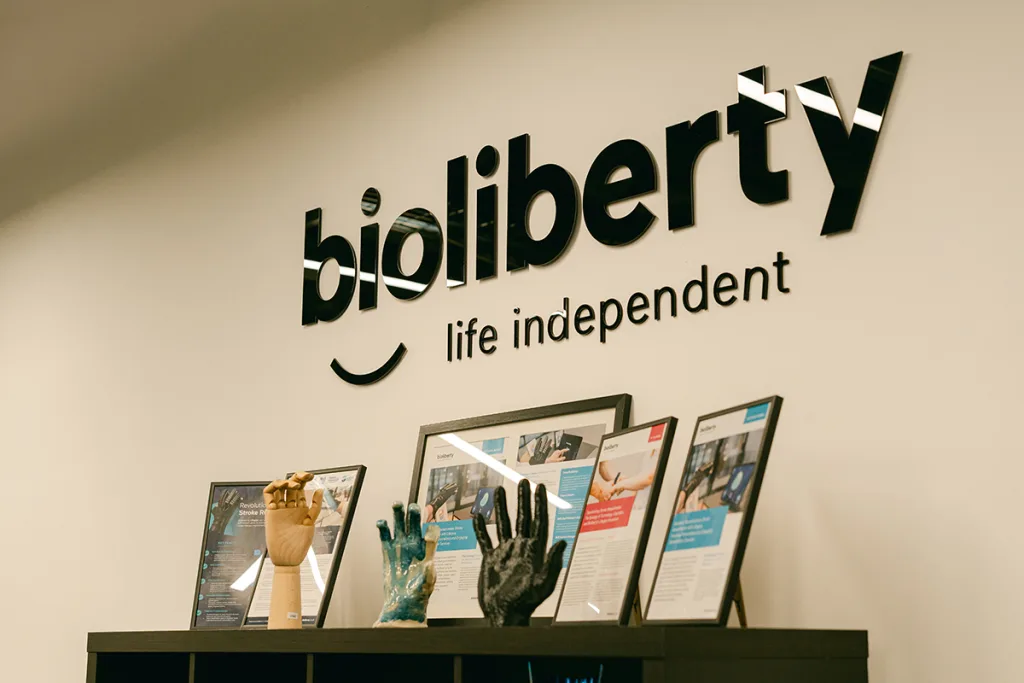
Based in Edinburgh, Bioliberty is an innovative medical engineering startup. Combining the latest AI, soft robotics, and gamified therapy tools, its technology helps people affected by mobility-limiting conditions and injuries. The goal is to help people regain their independence.
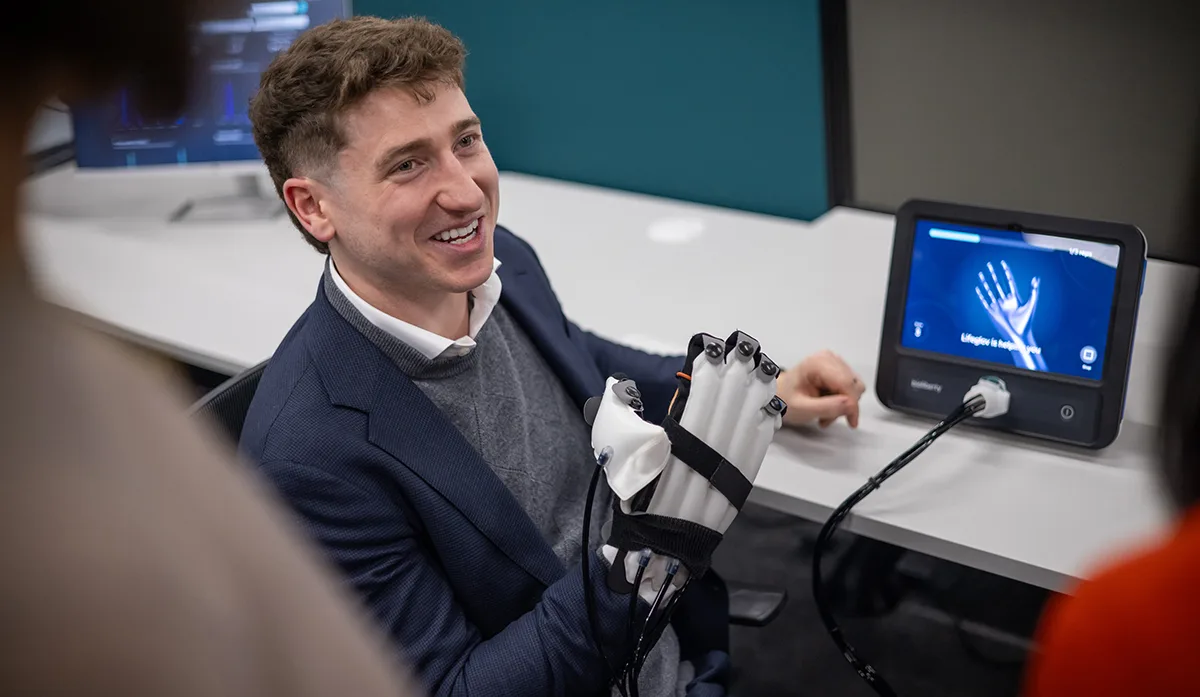
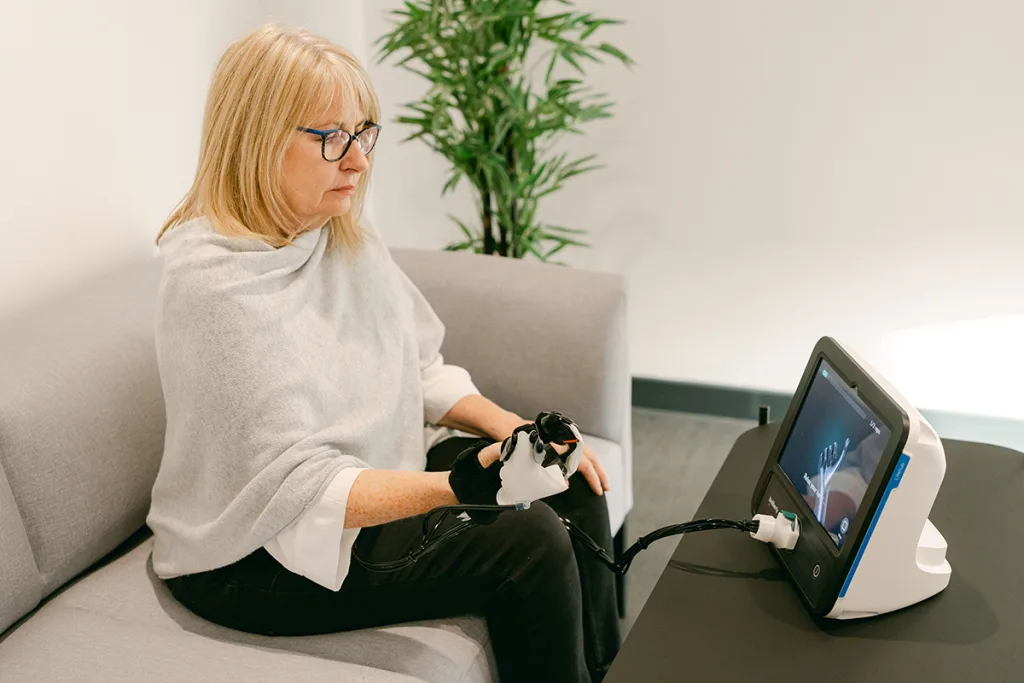
Initially addressing hand and upper limb mobility, the Lifehub control unit connects to the Lifeglov wearable technology. This air-powered robotic glove helps patients with their high-intensity therapy. In the background it captures and reports clear, objective data on the patient’s rehabilitation. The system is designed to facilitate more efficient treatment, accelerate recovery, and help therapists provide bespoke, effective care. It’s an approach that raised £7.7 million investment earlier this year. That will support further product development and manufacturing here in Scotland, and commercial expansion in the United States.
Origins
Bioliberty’s origins have roots in the University’s Masters’ in Electrical & Electronic Engineering with Management. It was on the degree, where co-founders Rowan Armstrong, now CEO, and Ross O’Hanlon, now Chief Technical Officer, first met.
“I was attracted to the University, primarily by the quality of the School of Engineering,” Rowan recalls. “At the Open Day, I loved the style of coursework and the industry connections. I also loved the extra-curricular side, including the Formula Student autonomous project, which involved designing a self-driving car.”

Ross agrees: “The world-class research and diverse clubs and societies attracted me to the University. I also loved Edinburgh as a city. Completing a Masters gave me a strong foundation in robotics, systems design and engineering. Importantly, I also gained an understanding of how to apply these skills in a commercial context.”
Both men took formative engineering roles after graduation.
“I moved into technology transfer,” Ross continues, “working with the GRID Innovation team at Heriot-Watt University, then at Edinburgh Innovations. My focus was on commercialising academic research and supporting early-stage ventures. That gave me valuable experience taking ideas from concept through to real-world application.”
“At Spacelabs Healthcare and Siemens Healthineers, I gained experience across both technical and commercial roles within the healthcare sector,” Rowan says. “That exposure helped shape my understanding of how technology can be translated into real clinical impact.”
Inspiration
It was during the Covid-19 pandemic that Ross had a ‘lightbulb moment’: “It started with something very personal,” he explains. “During lockdown, a close family member needed ongoing rehabilitation but suddenly could not access the therapy she needed. That highlighted how dependent recovery is on consistent, high-intensity therapy, and how quickly progress can stall when access is disrupted.
“My background gave me the confidence to approach this problem in a structured way. I understood how to break the problem down and start building something practical which could help.”

The next step was bringing the right people together. He continues: “Through university, I already knew others with complementary skills across engineering, healthcare, and commercialisation.”
Ross took his idea to Rowan. They brought in fellow engineers Conan Bradley and Shéa Quinn, both graduates of Queen’s University, Belfast. The team co-founded Bioliberty in 2020.
“Discussing the problem, it became clear that this was part of a much larger gap in rehabilitation delivery,” Ross said. “That insight shaped our approach, and we worked closely with clinicians and patients to build something grounded in real need.
“That combination of personal motivation, technical expertise, and access to a strong network gave us confidence to take the first step. Once you begin to see the potential impact, momentum builds quickly.”
Journey
That momentum has seen Bioliberty progress rapidly. They already have their products in the hands of therapists and in use in rehabilitation facilities. They are confident there is more to come.
“Our focus has been on developing solutions that support rehabilitation delivery, improve patient engagement, and provide better visibility into outcomes for clinicians,” Ross says.
“A lot of our journey has been about working closely with clinicians and patients to ensure we’re solving real problems. We have invested significant time validating both the clinical and commercial value of what we are building. That close collaboration has been central to getting us where we are today.”
Looking ahead, the focus in on achievable next steps but ambitious plans.
“In the near term, we’re focused on scaling adoption of our existing solutions and continuing to build strong clinical and commercial evidence,” Rowan says.
“Longer term, our goal is to transform how rehabilitation and functional assessment are delivered across care settings. From the clinic, into the home, we want patients to be able to access high-quality therapy throughout their recovery journey, while clinicians more accurately track their progress.
“We want to continue harnessing AI and what we call ‘spatial intelligence’ to simplify and enhance therapy delivery. This will help improve outcomes for patients, while making it easier for healthcare providers to deliver and manage care.”
Innovation ecosystem
Both Rowan and Ross credit the grounding and support they received from the University. That helped make their Bioliberty vision a reality. This included commercialisation support from Edinburgh Innovations and its Summer Startup Accelerator programme. They have also received early, and ongoing, investment from Old College Capital, the University’s venture investment fund.
Rowan said: “The University played an important role in shaping our mindset, and the early stages of Bioliberty. The focus on applying engineering to real-world problems, particularly in healthcare, helped frame how we think about building clinically meaningful and commercially viable solutions.
“We are especially grateful for Professor Adam Stokes and the role he played. His focus on entrepreneurship during our studies was truly formative. His teaching style, and the continued support he offered were instrumental in establishing Bioliberty’s foundations. He played a key role in building our early confidence and sparking our interest in medical devices and broader health tech.
“The University environment encouraged us to take ideas beyond research and into real-world application. That combination of technical depth, entrepreneurial thinking, and access to support, made it much easier to move from an initial insight to building a company around it.”
Ross agrees: “One of the real advantages of Edinburgh is the strength of its innovation ecosystem. Being part of an environment that includes initiatives like Edinburgh Innovations and facilities such as the National Robotarium means you are surrounded by people working at the intersection of research, engineering, and commercialisation.
“That ecosystem helped bridge the gap between early-stage ideas and real products. It made it easier to access expertise, build partnerships, and test concepts quickly in collaboration with clinicians and patients.
“It also creates a culture where taking something from concept to company feels possible and supported. That is incredibly important at the earliest stages.”
Social value
The significance of that culture is echoed by Professor Adam Stokes, the lecturer Ross and Rowan credit for his formative impact on their careers. Professor Stokes is Chair of Bioinspired Engineering at the University’s School of Engineering and Head of the Institute for Bioengineering. “I’m delighted to see Ross and Rowan continue to flourish,” he said.
“It has been a pleasure to support them through mentoring and encouragement, and to watch that early promise develop into something substantial. Their success is a reminder of how much talent can emerge when curiosity, technical ability, and determination are given the right environment to grow.
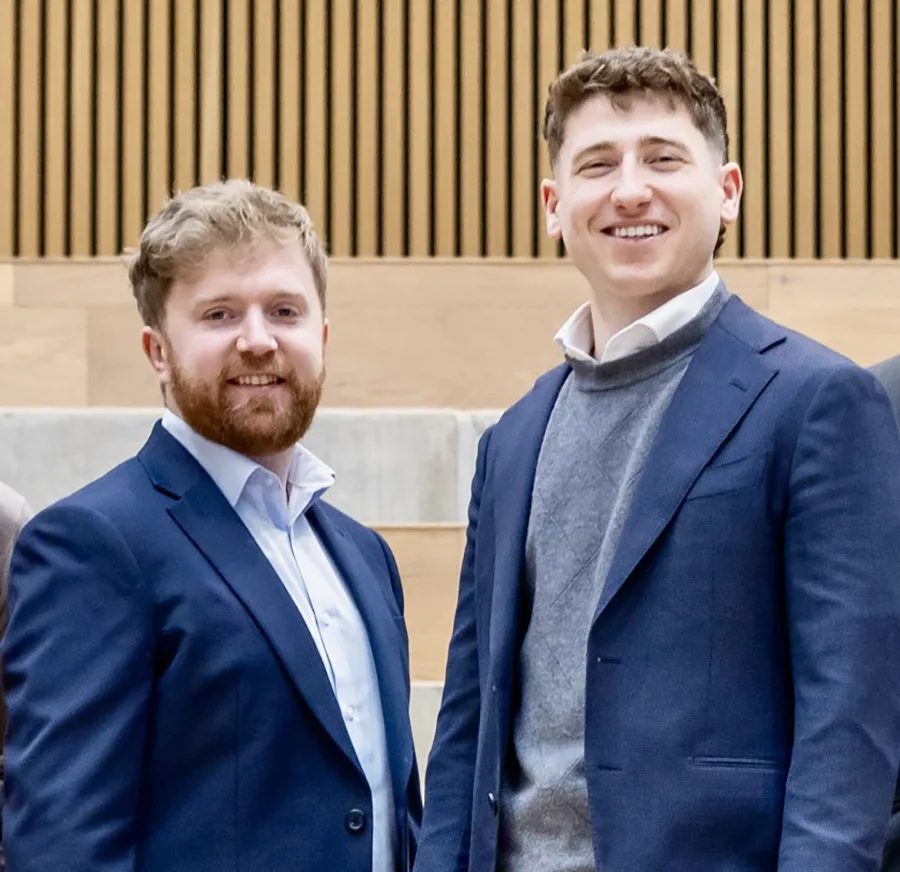
“Bioliberty is a brilliant example of entrepreneurship with real social value. Ross, Rowan, and the wider founding team have combined engineering skill with emotional intelligence, purpose, and follow-through to build something that is genuinely improving rehabilitation outcomes for real people. What stands out most is that they have not simply created technology for its own sake; they have developed a company rooted in a clear clinical need and a strong sense of impact.
Giving back
“Their journey also shows the value of a strong university ecosystem in turning ideas into investment-backed reality,” continues Professor Stokes. “By making the most of the support around them, they have transformed early momentum into real commercial and clinical progress, while contributing meaningfully to health tech innovation in Scotland and beyond. It is rewarding to see my former students take that path with such conviction, and even more rewarding to see the difference their work is now making in the wider world.”
Closing the circle, Bioliberty now gives back, appearing as guest lecturers to share inspiration and advice with the University’s current crop of students.
“It’s fabulous to see the reaction from the class to these young but experienced entrepreneurs giving back to the ecosystem that supported them in their early days,” Professor Stokes says.
Community
An important part of any successful culture is the people involved.
“There is a strong sense of community coming out of the University,” Ross says.
“Some of our investors and supporters have connections to the University, and that network has been important in our journey. One of our first investors was then Entrepreneur in Residence at the Bayes Centre, Andy Coleman. He helped us build connections with institutional investors for later funding rounds.
“What stands out is a willingness, from people who have gone through similar paths, to give back, whether through investment, mentorship, or introductions. It creates a sense that what you are building is part of something bigger. As we continue to grow, we are very conscious of contributing back to that ecosystem and supporting the next generation of founders coming through it.”
Footsteps
With that in mind, what advice do Bioliberty’s co-founders give to students hoping to follow in their footsteps?
“Take advantage of the breadth of opportunities available at the University,” Ross says.
“Spend time understanding real-world problems, particularly by engaging with clinicians, patients, or industry. You do not need to have everything figured out before you start. Bioliberty came from identifying a clear problem and being willing to explore it.
“Finally, build relationships early. The network you develop through university is one of the most valuable assets you will carry forward into your career.”
Track record
Bioliberty is not an isolated success story for the University. This is no one off. In 2024/25 alone, our student startups secured more than £11.8 million in investment, grants and funding. Edinburgh Innovations, the University’s commercialisation service, helped 55 new student startups that year. In the last four years, more than 350 student startups have been supported. Past successes include audio company Two Big Ears, acquired by Meta in 2016. For three years’ running, the University has ranked first in the world for industry, innovation and infrastructure in the Times Higher Education Impact Rankings.
Discover more
Image credits: Courtesy of Bioliberty and CroandKow