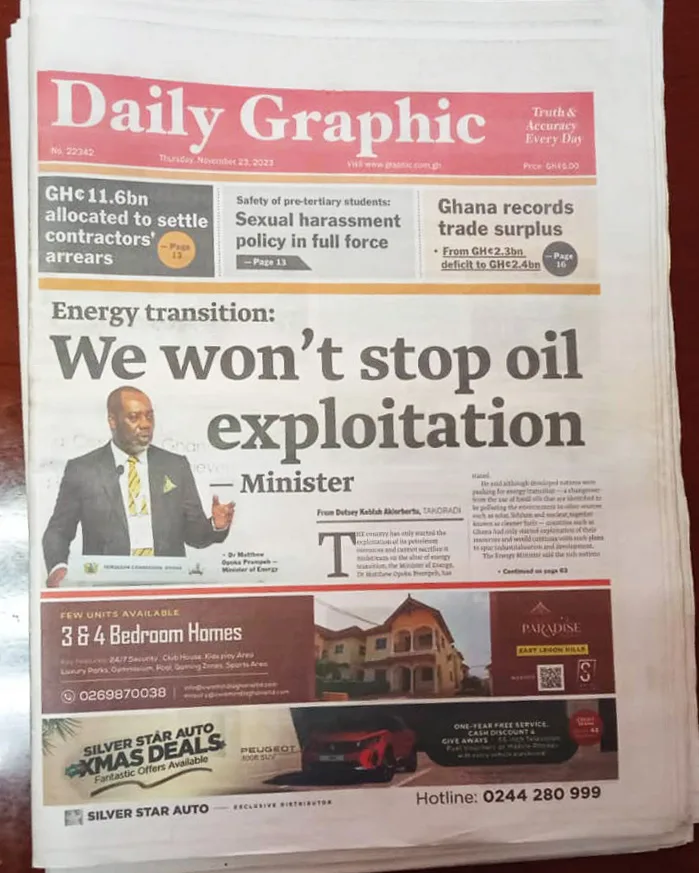
At the 26th UN Climate Conference in Glasgow, Ghana’s former President Nana Addo Dankwa Akufo-Addo declared1: “The Almighty has blessed our lands with abundant natural resources, and it would be wholly unfair for the world to demand that Africa abandons the exploitation of these same resources needed to finance her development…”
This poetic and politically charged statement encapsulates the moral dilemma at the heart of Africa’s climate discourse. It is a familiar refrain – one that invokes divine providence and historical injustice to justify continued fossil fuel extraction. Yet, mere days after this speech, the Ghanaian government inaugurated a National Energy Transition Committee2 to chart a path toward net-zero carbon emissions. This apparent contradiction is not incidental; it is emblematic of a broader paradox shaping Africa’s post-oil futures.
The double game of energy transition
Ghana, like many resource-rich African states, is engaged in a double game. On one hand, it has pledged allegiance to global climate goals, committing to a net-zero future by 2060. On the other, it is actively expanding its oil and gas infrastructure, including a Petroleum Hub initiative3 aimed at attracting petrochemical investments. This duality is not merely strategic; it is deeply political. Between 2016 and 2021, Africa attracted over 50 billion US dollars in new oil and gas investments, even as governments adopted net-zero targets. While critics often dismiss this as climate denialism or greenwashing, it reflects the structural contradictions confronting oil-rich African states: the imperative to finance development through proven commodities, juxtaposed with mounting pressure to conform to global climate orthodoxy.
Between 2016 and 2021, Africa attracted over 50 billion US dollars in new oil and gas investments4, even as governments adopted net-zero targets. While critics often dismiss this as climate denialism or greenwashing, it reflects the structural contradictions confronting oil-rich African states: the imperative to finance development through proven commodities, juxtaposed with mounting pressure to conform to global climate orthodoxy.
Beyond green dogma
Supported by the Carnegie Fund for the Universities of Scotland, my research – ‘Energy Compacts and the Burning Question of Africa’s Post-Oil Future’5 – explored these tensions within Ghana’s energy landscape. Over two years, we conducted interviews with more than 70 stakeholders and analysed a wide array of policy documents. A clear consensus emerged: climate change is real, and its impacts are devastating. Yet, there is a growing demand for realism – an insistence that energy security and economic justice must be central to any transition.
Ghana’s energy sector is beset by structural challenges:
- Over three billion US dollars in debt to Independent Power Producers (IPPs)6, leading to plant shutdowns.
- Approximately 40 per cent technical and commercial losses7 within the Electricity Company of Ghana (ECG).
- Renewable energy penetration remains at a mere two per cent8, despite abundant solar and wind potential.
- Regulatory bottlenecks and fragmented institutional coordination persist.
The government estimates that achieving net-zero by 2060 will require 550 billion US dollars in capital investment9. Yet current public and private commitments fall woefully short. Without bold reforms and robust governance, the energy transition risks becoming another illusion.
Climate justice or climate compliance?
The global climate regime often demands compliance without compensation. African countries are urged to phase out fossil fuels, but where is the support for alternative pathways? Where is the investment in green infrastructure, technology transfer, and capacity building?
This is not merely a technical debate; it is a moral and existential one. Ghana discovered oil barely a decade ago. During two rounds of workshops with policy actors and researchers in the energy sector, a recurring question emerged: Why should the country abandon a resource with proven developmental value, especially when wealthy nations continue to exploit theirs?
Extant scholarship offers critical insights into how states are embedded in energy-configured regimes. Concepts such as ‘fossil capitalism’10, Achille Mbembe’s ‘gestural symbols’11 and Jean-François Bayart’s ‘politics of extraversion’12 illuminate how African states often mimic global norms to secure legitimacy and resources, even when those norms conflict with domestic realities.
Reimagining the future
We must move beyond simplistic binaries – fossil or clean energy – and interrogate the deeper materialities and imaginaries that shape climate action. This includes:
- Justice and differential impact: How do colonial legacies shape Africa’s vulnerability?
- Livelihoods and local economies: What are the real costs of mitigation for communities?
- Political aesthetics: How is climate action expressed in governance and public discourse?
Ghana’s energy transition is not just about carbon, it is about sovereignty, development, and the future of the state. It demands a reimagining of what development means in a post-oil world. The path forward must be just, inclusive, and transformative – not merely dictated by external agendas but shaped by local realities and aspirations.

COP and the University of Edinburgh
Explore how we’re mobilising research and innovation to turn pledges into progress.
This article was first published in COP30 Advancing Action Brochure on 10 November 2025.
Photo credits: Newspaper graphic by Emmanuel Turkson; oil pipes by Kodda
- President Akufo-Addo Statement at The 2021 UN Climate Change Conference ↩︎
- Ghana Inaugurates National Energy Transition Committee ↩︎
- Ghana begins construction of $12 bln petroleum hub ↩︎
- International Energy Agency – Africa ↩︎
- Energy Compacts and the Burning Question of Africa’s Post-Oil Future ↩︎
- President meets Independent Power Producers ↩︎
- ‘ECG’s collection losses at 15%, distribution at 40% not sustainable’ – Prof Bokpin warns ↩︎
- Prosperity Post Fossil Fuels Briefing Ghana ↩︎
- Ghana Energy Transition and Investment Plan ↩︎
- Fossil capitalism, climate capitalism, energy democracy: the struggle for hegemony in an era of climate crisis ↩︎
- The Banality of Power and Aesthetics of Vulgarity in the Postcolony – Achille Mbembe ↩︎
- Africa in the World: A History of Extraversion ↩︎