We have built an economy that digs up finite resources, uses them briefly, and buries or burns what is left.
Plastics and metals sit at the heart of that model. Each is an essential material for modern living and is a crucial enabling resource for a more sustainable and healthy future for people and planet. Yet more than 75 per cent of the plastic that has ever been made is now waste;1 2and global recycling of rare earth elements is just one per cent.3 The circular economy, where ‘waste’ is repurposed as a resource, proposes a better way, yet so far has not been implemented at scale.
Engineering biology enables circularity by design
The road to Antalya is being framed around delivery: the COP 31 Presidency has set out to move from agreed ambition to practical results, guided by dialogue, consensus and action. Its Action Agenda places zero waste and green industrialisation alongside clean energy and electrification. This is a welcome opening for enabling technologies, such as engineering biology,4 which to date has received far too little attention in climate discussions particularly in terms of the role it could play in addressing the climate and environmental crisis.
Engineering biology is a set of tools capable of doing the hard molecular work under the traditionally ‘mild’ conditions needed to enable a circular economy.
New solutions for old problems
Consider plastics first. Mechanical recycling, the shredding and remelting, works tolerably well for clean, single-polymer streams such as drinks bottles. It works badly for everything else. Mixed plastics, multilayer packaging, dyed and contaminated materials, and textiles blending several fibres, degrade with every cycle or simply cannot be processed. Much of what we put in the recycling bin is downcycled into lower-value products or quietly diverted to landfill and incineration.
Metals present a different problem. Steel and aluminium recycle well, but the critical metals that power the energy transition, such as lithium, cobalt, nickel and the rare earth elements, are often present in tiny quantities, locked into complex electronics and batteries. Conventional recovery relies on energy-hungry smelting or on harsh chemical leaching, which generates hazardous waste.
Meanwhile, demand for these materials is set to climb steeply as we electrify transport and decarbonise power. Both problems share a root cause: our existing processes are blunt instruments applied to intricate materials. Biology, by contrast, has spent billions of years perfecting precision chemistry at ambient temperature and pressure.
The power of enzymes and microbes
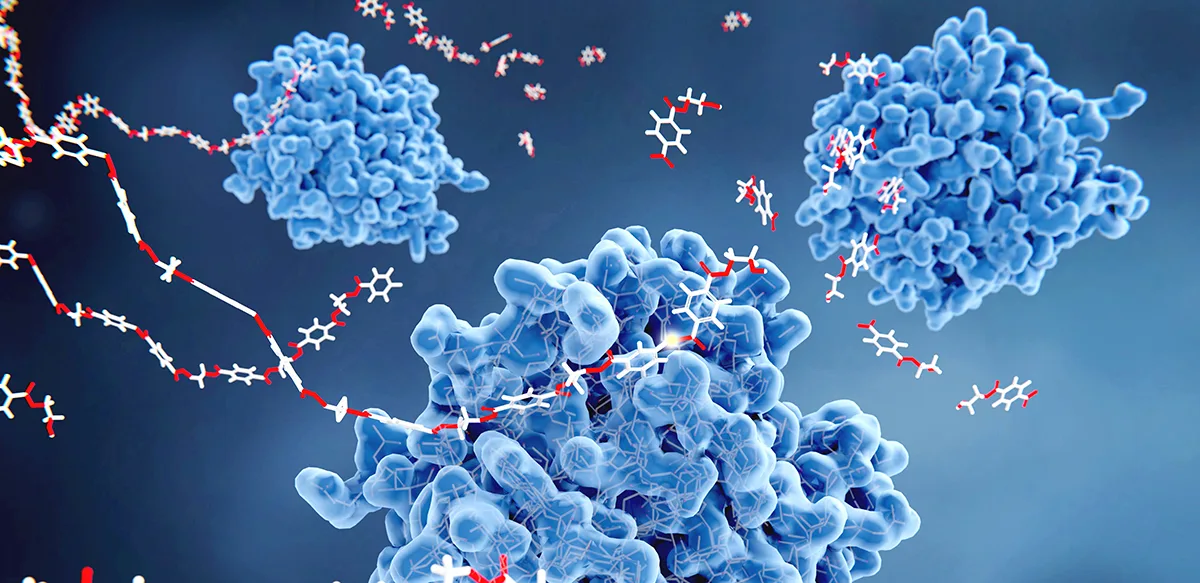
The most striking demonstration of what engineering biology can do for plastics is enzymatic recycling. In a global effort, researchers have discovered, and then engineered, enzymes capable of breaking down PET (polyethylene terephthalate), the polymer used in single use drinks bottles, food packaging and polyester clothing, back into its chemical building blocks. Protein engineering, now turbocharged by AI-based structure prediction tools like AlphaFold, has made these enzymes faster, more stable and more tolerant to industrial conditions than anything found in nature. The significance is not merely that plastic can be degraded. It is that it can be rapidly depolymerised into pure monomers, which can then be used to make new plastic indistinguishable from virgin material.
Further, enzymes or microbes can be designed to take these monomers and use them as a feedstock to make new, higher value chemicals like perfumes, flavouring and medicines. Because enzymes and microbes work at modest temperatures, the energy demand is lower than for thermal routes, and because they are selective, they can in principle tease apart the mixed and contaminated waste that defeats mechanical recycling.
Researchers at the University have shown that engineering biology also works at the other end of the lifecycle, and we can embed principles of the circular economy into this process by design. Carbon rich waste streams from industry, including plastic waste itself, can be fermented into building blocks for bio-based polymers such as polyhydroxyalkanoates (PHAs) and polylactic acid (PLA), which can then be safely depolymerised under industrial composting conditions.
These bio-based plastics in themselves also pose an ideal feedstock for biological upcycling, pointing towards a future plastics economy, enabled by engineering biology, which operates independently of fossil-derived carbon.
For metals, the biological toolkit is just as compelling, if less widely appreciated. Microbes have been used in mining for decades: biomining, using bacteria to help extract copper and gold from low-grade ores, already accounts for a meaningful share of global production. What is new is the ability to engineer these organisms, and the proteins they produce, for greater selectivity and efficiency.
Engineered bacteria and designed proteins can bind specific metal ions with extraordinary selectivity. This allows rare earth elements with near-identical chemical properties to be separated from one another, a task that currently requires dozens of energy-intensive solvent extraction stages.
Researchers at Edinburgh are showing microbes can transform low-concentration waste into valuable feedstock without the furnaces and mineral acids of conventional routes, when applied to electronic waste, spent lithium-ion batteries and industrial effluents. Those same approaches also apply to bioremediation, as the organisms that capture metals from waste can also clean contaminated soil and water.
Closing the materials loop
If we want a circular economy for plastics and metals rather than merely an aspiration for one, there are many gaps to close. That means public-private partnerships to create scale-up and follow-on facilities. It means non-dilutive proof of concept funding to support the transition from academic laboratory research to higher technology readiness levels where most commercialisation endeavours fail, thereby carrying promising science across the ‘valley of death’. And it means a skills pipeline, including retraining chemical and process engineers from the petrochemical sector, whose expertise in large-scale processing is exactly what biomanufacturing needs. There is a neat symmetry in workers who built the fossil economy being retrained to help replace it.
Engineering biology is not a magic wand, and advocates do themselves no favours by pretending otherwise. Technical challenges must still be addressed for biological recycling and upcycling to compete on cost with cheap virgin plastic and petrochemicals. Indeed, success here will underpin all subsequent attempts at scale-up and deployment. This must also be incentivised by policy that properly values recycled and non-fossil carbon derived content.
Biological metal recovery is still maturing, and some processes are slow compared with smelting. Regulation of engineered organisms remains uncertain and differs globally, which matters for any company planning to deploy them. And the best circular economy is one that reduces consumption first; biology should complement reuse and reduction, not excuse us from them.
Public trust matters too. Genetic technologies provoke understandable questions, and the sector must be open about how engineered organisms are contained and governed. Dismissing those concerns would be both arrogant and strategically foolish.
Still, the direction of travel is clear. The linear economy is running into resource limits, climate targets and public impatience. The tools to replace it are emerging, and they are increasingly biological. Countries that build the skills, facilities and regulatory clarity to use them will capture the jobs and the value; those that hesitate will import the technology, and the benefits, from elsewhere. Plastics and metals are not going away. The question is whether we keep digging and dumping, or learn to grow, recover and reuse. Engineering biology offers a credible way to do the latter, and the time to act is now.
This article was first published on 9 November 2026 in Advancing action: The University of Edinburgh’s research and reflections for COP 31 and the future.
Discover more about
Photo credit: main image of an illustration of PETase enzymes breaking down plastic, Juan Gaertner/Science Photo Library via Getty.
- Production, use, and fate of all plastics ever made ↩︎
- Chapter 2 – Production, use, and fate of synthetic polymers ↩︎
- Recycling of the rare earth elements ↩︎
- Engineering Biology: An interdisciplinary field that applies rigorous engineering principles to the design, scaling, and creation of new or modified biological systems. It can function as a transformative biomanufacturing platform that eliminates waste and decouples carbon-based molecules from fossil resources by looping nutrients into the production cycle. ↩︎