We take a look at this drive for physical presence even in an increasingly digital world.
When Rasa, one of the world’s fastest-growing generative AI companies, headquartered in California, were seeking a new European hub to drive forward research and software development, one city stood out.
With a reputation for excellent quality of life as well as for innovation, and strengths in key sectors including finance, public services and tourism, Edinburgh soon became the favoured host for a new base. What sealed the deal for the Rasa team was the University’s extensive history in AI natural language processing research, as well as Scotland’s vibrant tech ecosystem. With co-founder, Alan Nichol, also a University alum, bedding in with a physical presence on campus made perfect sense. Rasa established a space in the University and hasn’t looked back.
Tenancies like Rasa’s are increasingly common across our campus as companies start to take notice of how powerful it can be for business when commercial acumen meets research excellence and an unsurpassed pool of talent, with Edinburgh Innovations, the University’s commercialisation service, on hand to foster these relationships.
Now, as students make their way to lectures and staff to meetings, what they might not know is that just a few yards from the lecture theatres and seminar rooms that typify our idea of a traditional campus, lie some of the biggest and most dynamic companies on the planet.
Thriving ecosystems
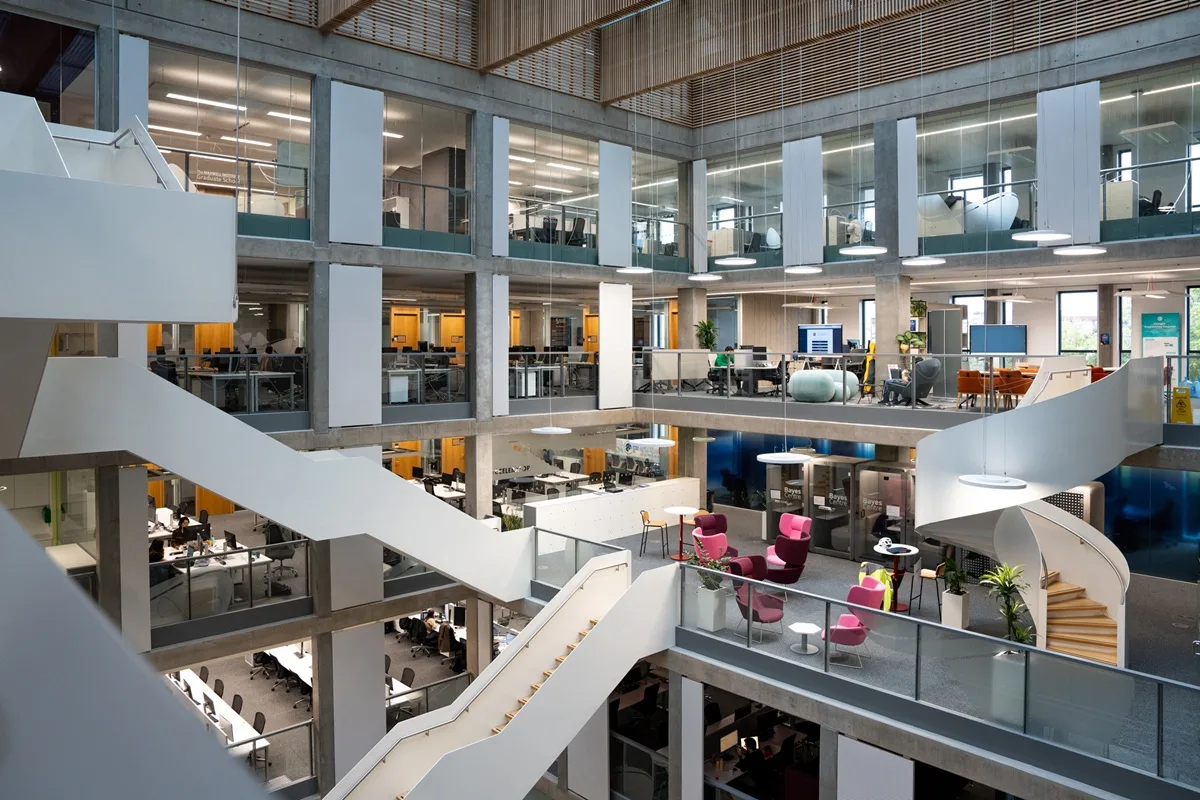
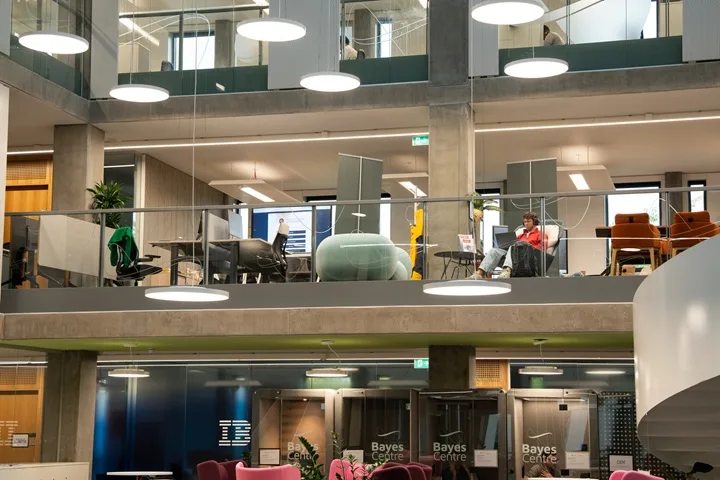
The Bayes Centre is the University’s innovation hub for AI and data science and one of five Data-Driven Innovation (DDI) hubs, supported by the Edinburgh and South East Scotland City Region Deal. Bayes hosts a number of data-driven businesses, as well as renowned venture building and accelerator programmes for aspiring AI and tech company founders.
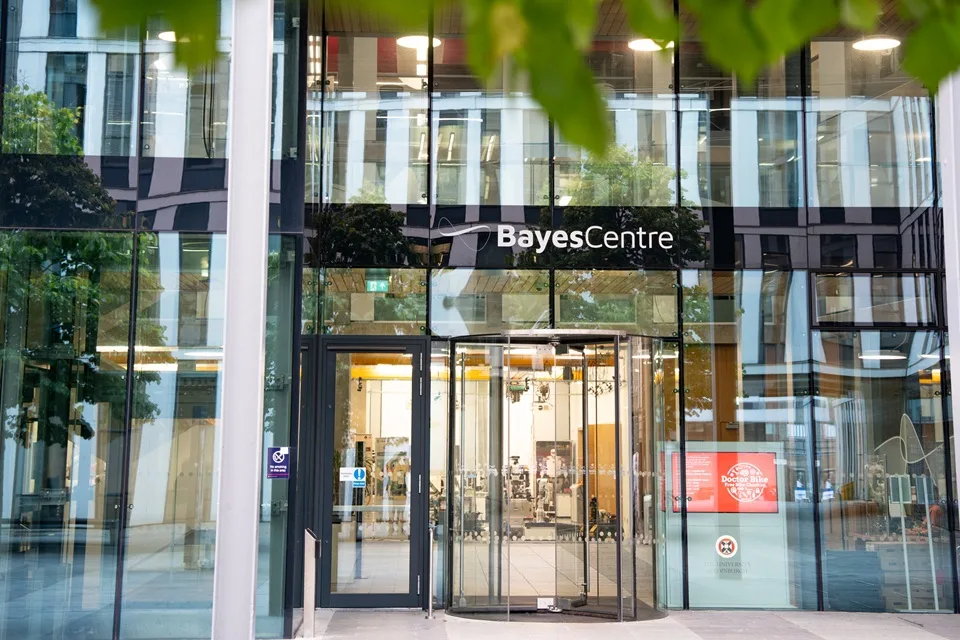
Tucked between Bristo and George Squares, the Bayes Centre, part of the College of Science and Engineering, is a glass-fronted building that staff and students have likely walked past hundreds of times without knowing what goes on within. Behind the unassuming façade, the Centre has been growing one of the most exciting places to learn and study in the country, with a flourishing entrepreneurial culture that is bringing enormous benefits to students, to businesses, and to Scotland.
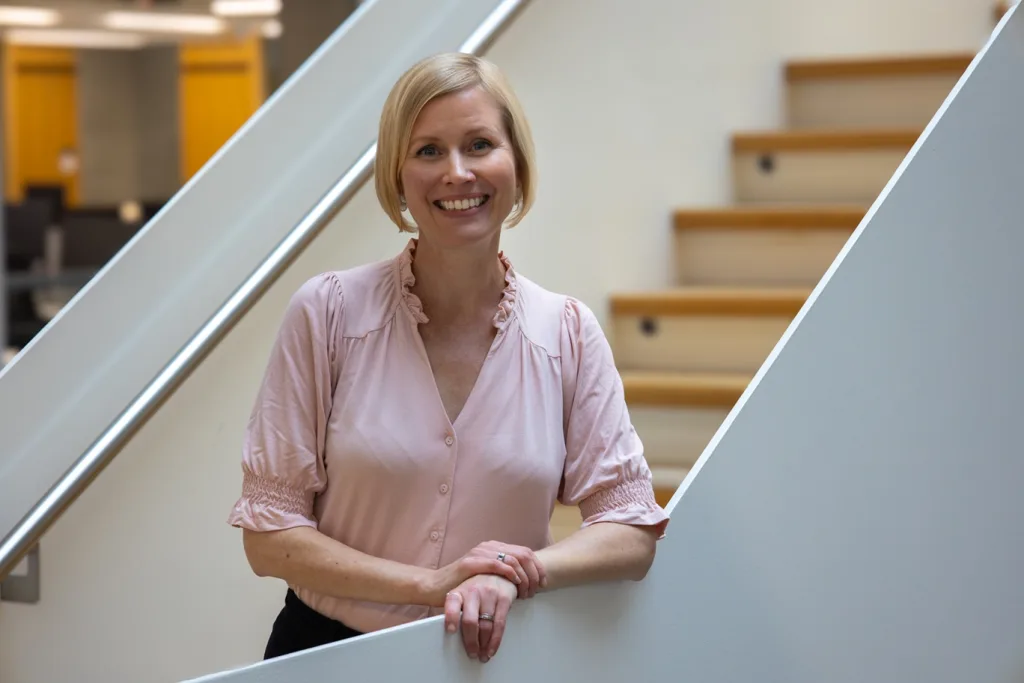
We find that physical co-location offers the chance for those gold-dust informal interactions that spark unexpected insights. There’s this unique chance to have conversations that could snowball into collaborative grants, funded research projects, co-published findings and the next big idea.
The Bayes Centre is really unique across the University with its focus on AI and data-driven business and its track record in turning research into commercial reality. With tenancies, the Centre has become a real coalface between students, researchers and business, and for our tenants it’s really a very energising place to be.
Charlotta Cederqvist, Head of Business Engagement for the Bayes Centre
Professor Ruth King, Director of the Bayes Centre and Thomas Bayes’ Chair of Statistics at the School of Mathematics, believes that hosting tenancies atBayes also brings a wealth of benefits for students across the University, from undergraduates to PhD students working on cutting-edge research projects.
Tenancies continue to provide valuable industry experience for students, including sponsoring MSc projects in areas such as AI-driven therapeutics, machine learning-enabled renewable energy, and intelligent shopping assistants. Close proximity to an exceptional talent pool of students benefits tenants too, and for example, since arriving in the city, Rasa has hired no less than 10 Edinburgh graduates.
“For our students, what better way to enhance their skillset than by having this envious access to companies, the real-world challenges they are tackling, and the data-driven solutions they are working on,” Ruth said.
Global giants
Even in this tech-led, post-Covid world, business leaders recognise that there is no substitute for physical presence for building partnerships. For an entrepreneur with a fledgling business, that attraction might be more obvious. A couple of desk spaces instead of a full office keeps costs down and allows data companies to plug into an existing network of like-minded entrepreneurs and inspiring minds, keeping the business innovative as well as lean.
However, as well as start-ups, spinouts and smaller enterprises, which are vital to the economy, DDI hubs now also have successfully built a home for some very familiar household names, allowing staff and students to rub shoulders with leaders from true global giants, including SAS, who have been tenants in Bayes since its opening.
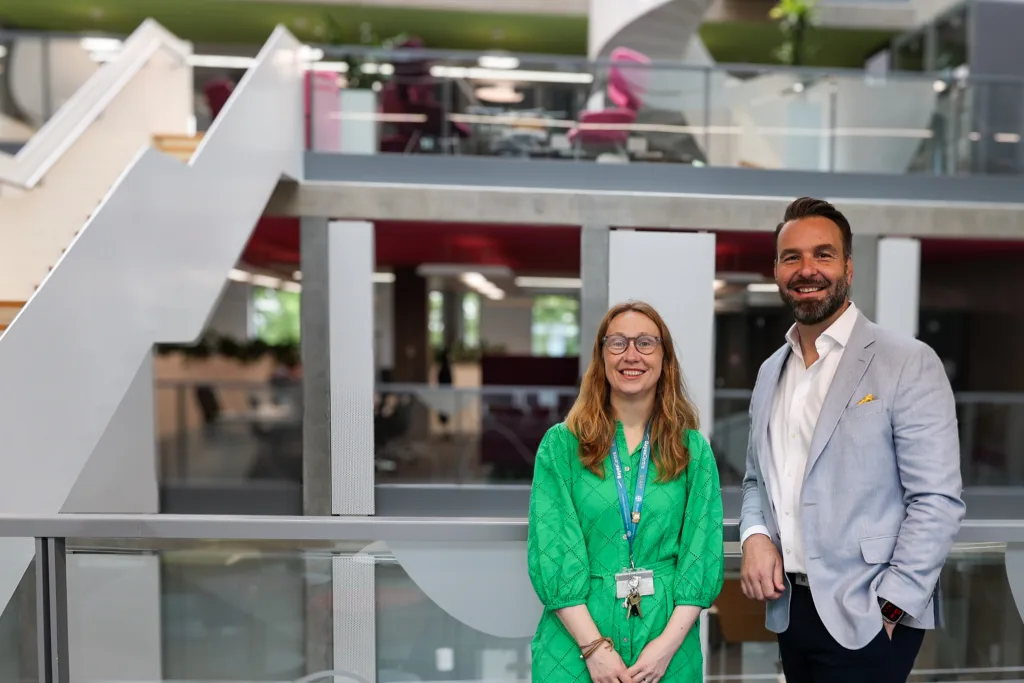
In November 2025, in a Scottish university first, global technology leader IBM took up a tenancy at Bayes, in tandem with a programme to develop a deep partnership with the University that would benefit researchers and students alike. The move marked a huge seal of approval for the University as an innovation hothouse and leader in AI, and cemented Edinburgh’s reputation as a great bet for investment.
Explaining their attraction to their new location at the welcome launch event at the Centre, IBM leaders outlined how its physical presence in the building allows for closer collaboration and proximity to cutting-edge innovation. Since the launch, the company has hosted a number of events at Bayes, including their European Summit for Quantum, an area with existing collaboration with the University’s Quantum Labs.
What makes Edinburgh so attractive?
So why Edinburgh, and why this University? For many tech companies the answer is clear cut – an almost unparalleled standing in AI and data research. The University has been at the forefront of AI research for more than sixty years, and continues to drive innovation in this field, including leading the UK arm of a new European project to enhance adoption of AI, and hosting some of the UK’s most powerful compute infrastructure, including the UK’s national Supercomputer.

Scotland’s technology is growing and the tech ecosystem contributes an estimated £6bn to the economy. As Reuben Aitken, Managing Director for International at Scottish Enterprise and Scottish Development International, explains, “In a world increasingly shaped by data and AI, Edinburgh stands out because it combines what investors need most: exceptional talent, data assets they can trust, advanced computing infrastructure and a culture of collaboration.
“The result is an ecosystem where ideas move quickly from research to real-world applications, making Edinburgh one of Europe’s most compelling destinations for data-driven investment. Edinburgh offers globally recognised AI research and specialist facilities, industry partnerships, and a proven track record of turning innovation into commercial success.”
Start up and industry leaders seem to agree. Modular – an AI infrastructure tech and hardware company based in San Francisco – named the University an obvious choice for its European office, plugging into an existing innovative culture of students and academics offers expertise and advice from the world’s brightest minds. As a spokesperson for Modular put it, Edinburgh’s School of Informatics is one of the largest and most respected computer science departments in Europe, and the broader Scottish AI community has produced foundational work in machine learning, natural language processing and systems engineering.
Jamie MacDonald, Director, Infrastructure and Security at Rasa, said: “Edinburgh was a clear choice for our new European hub due to its established strengths in AI and natural language processing, as well as Scotland’s vibrant tech ecosystem. Rasa’s co-founder, Alan Nichol and I are both University alumni, so bedding in with a physical presence on campus made perfect sense.”
This rich heritage is not just a proud legacy for the University – it’s a living and thriving foundation, providing solid foundations from which new companies can grow.
AI for good
The University’s three core missions in research and innovation – AI and data, health and climate, are reflected in the companies that take up tenancies, helping to drive forward these strategic areas. While we often hear about how AI will drive job crises and have a profound ecological impact, many of the companies based at Bayes exemplify how AI can be used for good, benefitting society and the environment. For example, dot, which uses AI and scent science to detect pests and disease earlier, is using tech to predict risks and protect communities, supply chains and ecosystems.
Another example is Environment Systems, which delivers data, mapping and consultancy services to support sustainable land management and biodiversity conservation. The company aims to help governments, businesses and conservationists make informed decisions about natural resource management and environmental impact.
The team behind Snugg, which develops energy efficiency technology, are trying to help people make energy savings within their own homes. Based at the Bayes Centre, they combine data analytics and machine learning to create personalised energy-saving recommendations, which they say contributes to the UK’s net-zero targets and makes energy improvements accessible for homeowners.
Snugg CEO and Co-founder, Robin Peter, said: “The real sense in the building is optimism around AI and a shared belief that we can develop tech and data for good. We enjoy the spontaneous interactions we get with people with future-focused mindsets, and regular contact with founders from different organisations working on different challenges creates a constant exchange of ideas, perspectives and expertise.”
Physical presence in a digital world
Even in this digital world, the companies thriving at Bayes and the DDI hubs are evidence that physical presence on campus provides unique benefits, turning ideas into reality and contributing to tangible economic growth.
Bayes sits firmly at the centre of a golden triangle between research, business and civic engagement and other DDI hubs are mirroring its tenancy success. At Edinburgh Futures Institute, tenant Aveni, which spun out of the School of Informatics, recently announced that it had raised £12m to drive agentic AI adoption in financial services.
The continued success of Bayes as an entrepreneurial hot-house is proof that placing universities at the heart of enterprise is a powerful model for future development, for staff, for students, and for driving the economy.
Tenancies are available in our DDI hubs, including Bayes, Usher Institute and Edinburgh Futures Institute.
Interested in tenancies at our DDI hubs?
Salisbury Crags image credit Chris Close