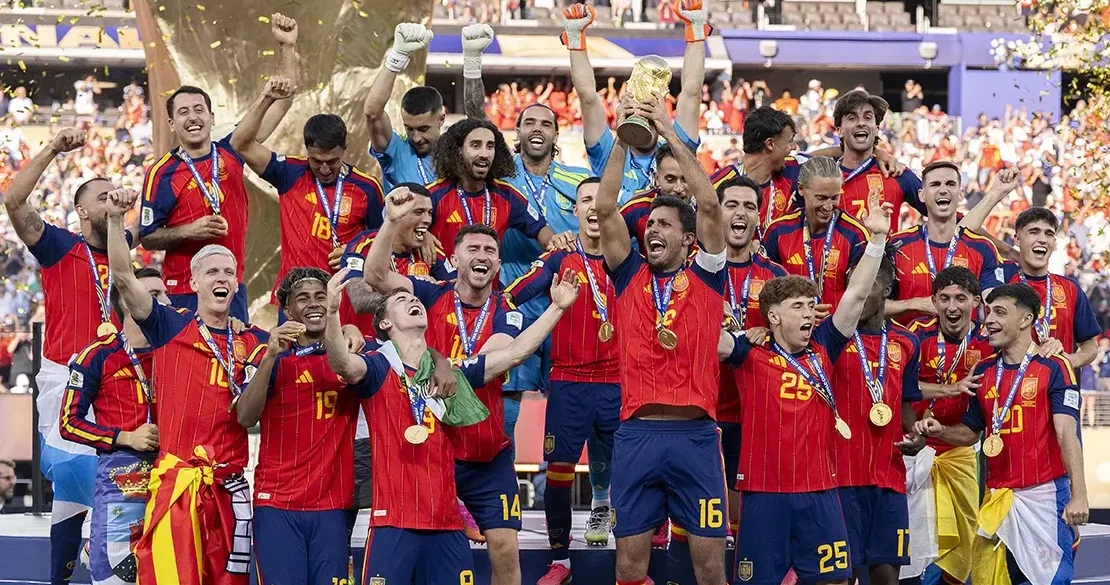
Saying who the winners of the FIFA 2026 Men’s World Cup were is, at one level, an easy question to answer: Spain. The reigning European football champions defeated Argentina on 19 July at the MetLife stadium in New Jersey.
FIFA estimates that about 1.5 billion people watched the final in some capacity. Of the tournament’s $871 million (US) prize money, Spain won $50 million. That is $8 million more than Argentina received for lifting the trophy in 2022.1 With their victory, Spain became the first nation ever to simultaneously hold both men’s and women’s FIFA World Cup titles. Spain also lifted the 2023 FIFA Women’s World Cup.2
While Spain were the ultimate winners, there were other winners on the pitch.
Historic firsts
Curaçao, Jordan, and Uzbekistan all celebrated historic ‘wins’ just by qualifying and making their official World Cup debuts on the global stage. Cape Verde, the second-smallest population to ever qualify for a World Cup, went undefeated in the group stage. They held eventual winners Spain to a 0–0 draw and drew 2–2 with Uruguay. For the first time in World Cup history, the world’s top four ranked teams – Argentina, Spain, France, and England – made up the four semi-finalists.
The Tartan Army were also winners. They arrived in Miami and Boston, dressed differently, singing loudly, and donating to local charity. They projected a version of Scotland as generous, self-deprecating, and outward looking – a positivity that no marketing campaign could manufacture.
Off and on the pitch, teams like Morocco might also be viewed as victors. Morocco became the first African and Arab nation in history to reach the World Cup quarter finals in consecutive tournaments (Qatar 2022 and North America 2026).3
For Morocco, football is a central pillar of foreign policy with a $5 billion fund to support investment in and partnership with the country. Morocco is tactically executing a state-led sports diplomacy strategy. This leverages its co-hosting of the 2030 FIFA World Cup to structurally transform its trade relationships with Europe, and position Morocco globally. Morocco’s experience demonstrates how football can be integrated into a wider international development strategy that delivers football and non-football returns through the sport.
International influence
Morocco’s approach demonstrates that football can be strategically leveraged. That is, not merely to win matches, they are ranked seventh in the world, but to strengthen international influence, attract investment, support economic modernisation, and enhance the country’s global standing.4
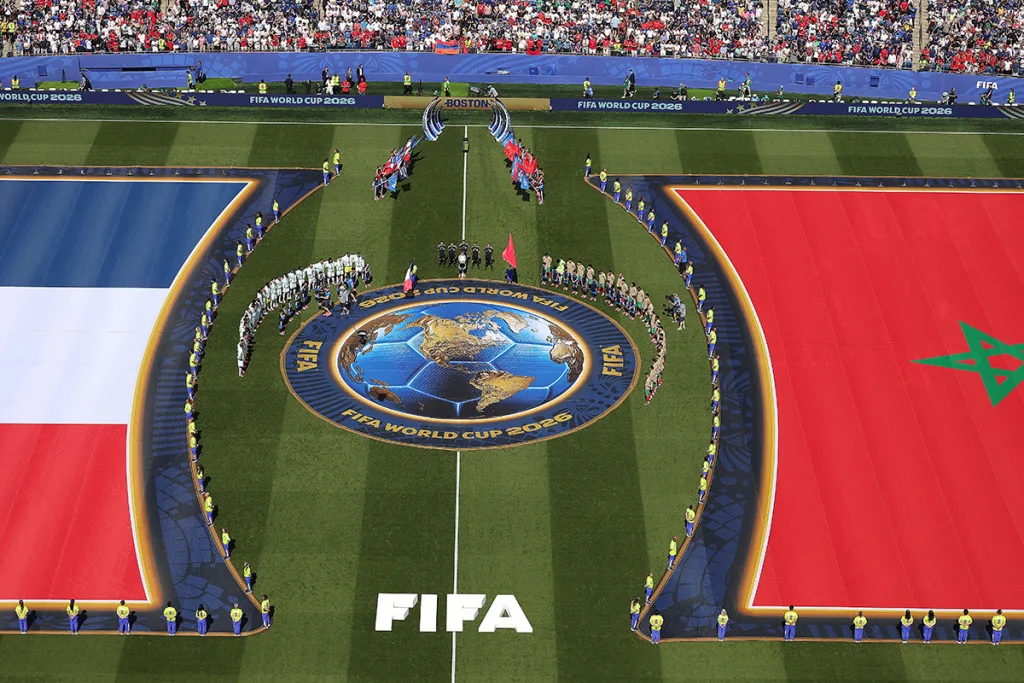
FIFA might be viewed as the financial victor, capturing nearly all broadcast rights, global sponsorships, and ticket revenues. Because they rented pre-existing NFL stadia, rather than funding any new construction, FIFA avoided infrastructure costs while aggressively maximizing profits through US-style dynamic ticket pricing. Total stadium attendance surpassed 6.66 million spectators with a 99.7 per cent stadium occupancy rate. Big corporate companies were also winners with tech firms and institutional backers like Bank of America capitalising on a global audience. Luxury hotels and major airlines also enjoyed massive revenue spikes from wealthier domestic travellers.
Analysts such as BMO and Allianz noted that the event functioned as a short-duration demand spike, rather than a permanent growth driver. It added roughly 0.1 to 0.3 per cent to the quarterly GDP of Canada, Mexico, and the US.5 All three host countries successfully reached the knockout stages by advancing to the Round of 16, with the USA scoring an all-time tournament-best 11 goals. On the pitch and in the streets, the event delivered potential long-term value for ‘soccer’s’ North American footprint.
Losing out
Arguably, host cities, fans, and tourists might be viewed as having lost out. While cities like Boston reported intense restaurant spending around games, economists note that the World Cup heavily ‘crowded out’ normal, long-term summer tourism.6
Most of the 16 host cities spent more than $100 million on security, logistics, and transit. Because money spent at FIFA events immediately exits the regional economy, some local authorities are facing fiscal deficits. Outrageously priced tickets (some breaking $11,000) transformed the tournament into an elitist playground, pricing out many ordinary football fans.
FIFA might also be viewed as a political loser. Critics point to the awarding of the FIFA Peace Prize, the Folarin Balogun red card scandal, and unequal treatment of warring nations at the World Cup, as crossing red lines in terms of levels of political interference.
The FIFA President’s subsequent proposal to sell stakes in the World Cup to private investors is arguably the biggest threat to the football landscape since the proposed European Super League.7 For some, this is a struggle for the heart and soul of world football, what it should be like, and who controls it.
Threats
The move to privatisation could threaten women’s football, and professional player welfare, not to mention the integrity and geopolitical landscape of the game.
The proposals could significantly affect women’s football. The 2027 Women’s World Cup, in Brazil, is FIFA’s next major global tournament on the calendar. European nations are actively discussing using a boycott of the women’s tournament as their primary leverage and threat against FIFA.
All of this, and more, is the emerging backdrop to a FIFA Presidential election due to be held in 2027. Europe is the likely opposition on both fronts. European nations such as Norway have filed a formal ethics complaint, while UEFA is threatening a total boycott of both the 2027 and 2030 World Cups. The irony of all this being that Gianni Infantino was elected following a previous FIFA Presidency scandal involving Sepp Blatter, and on the promise of cleaning up the game.
The 2026 FIFA World Cup helped to yet again demonstrate that football has scale, reach and popularity. Reach is not impact, with the reality being that there were several winners and losers, on and off the pitch.
Image credits: Getty Images | David Ramos (main image) and Alex Slitz
- Silverman, A (2026). Spain wins World Cup, capping wildly successful North American tournament. Sports Business Journal, 19 July 2026. ↩︎
- Hughes, M (2026). Spain win the World Cup after Ferran Torres dethrones 10-man Argentina in extra time. The Guardian, 19 July 2026. ↩︎
- Bouaichi, C (2026). Morocco Rewrites History at 2026 World Cup with Record-Breaking Campaign. Morocco World News, 10 July 2026. ↩︎
- Jarvie, G and El Ghita, H, (2026). Scotland and Morocco on and off the pitch. Edinburgh. ↩︎
- Allianz Trade, (2026). From kick-off to cash flow – Economic spillovers from the Football World Championship 2026, 10 June 2026. ↩︎
- Allianz Trade, (2026). From kick-off to cash flow – Economic spillovers from the Football World Championship 2026, 10 June 2026. ↩︎
- Stone, S, (2026). Fifa offers $40m if nations back controversial plan. BBC Sport, 29 July 2026. ↩︎