
During 2026, the National Year of Reading, we ask our teachers of all things literary, just what they recommend as a good read, and which books inspire them in their teaching.
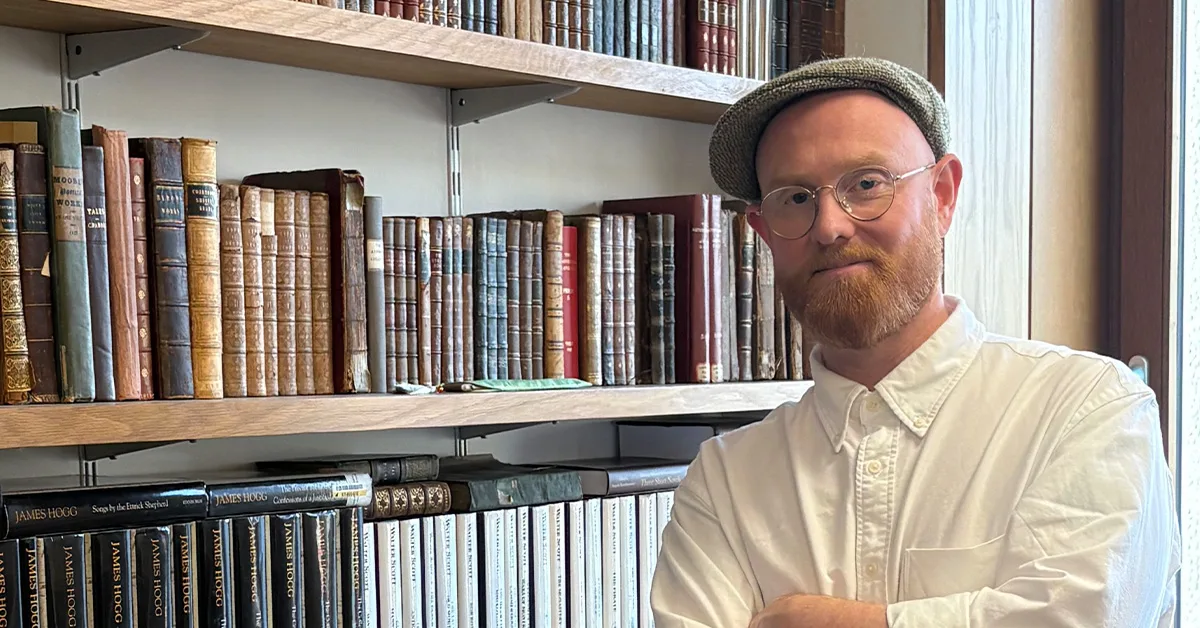
Dr Gerard McKeever, Lecturer in Modern Scottish Literature
Which book do you love using in your teaching and why?
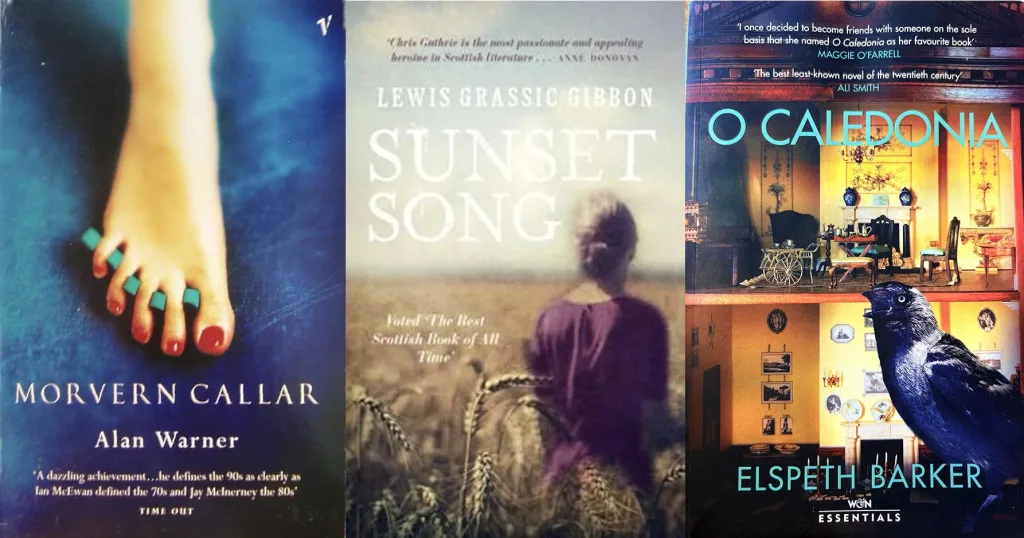
I get to teach some amazing work, from Joanna Baillie to Muriel Spark, but the lectures I enjoy giving the most are on Lewis Grassic Gibbon’s Sunset Song (1932) and the wider trilogy called ‘A Scots Quair’ it forms with Cloud Howe (1933) and Grey Granite (1934). I find Sunset Song in particular tremendously moving every time I return to it; it manages to sustain the intensity of a lyric poem for the duration of a novel.
In my seminars, I usually get a strong response to Elspeth Barker’s O Caledonia (1991), which is an idiosyncratic, playfully Gothic novel about a girl growing up in the Highlands. She’s murdered on the opening page. I find that the students who like it adore it.
I’ve also enjoyed teaching Alan Warner’s Morvern Callar (1995) this semester. Almost everyone in the room will have a different take on that novel. It’s so strangely flat, so oblique, it’s like a mirror that shows you whatever you want.
Which book to you return to for inspiration and personal enjoyment, or do you never return to a title once you’ve read it once?
Well, scholars of literature only ever ‘re-read’ books, of course, even when we’re actually approaching them for the first time (!).
Being completely honest, I don’t find the time to revisit books purely for pleasure all that often, unless I’m reading to my kids (Mairi Hedderwick’s Katie Morag and the Two Grandmothers [1985], for instance). Still, one of the nice things about my job is that most of the reading I have to do, I also want to do.
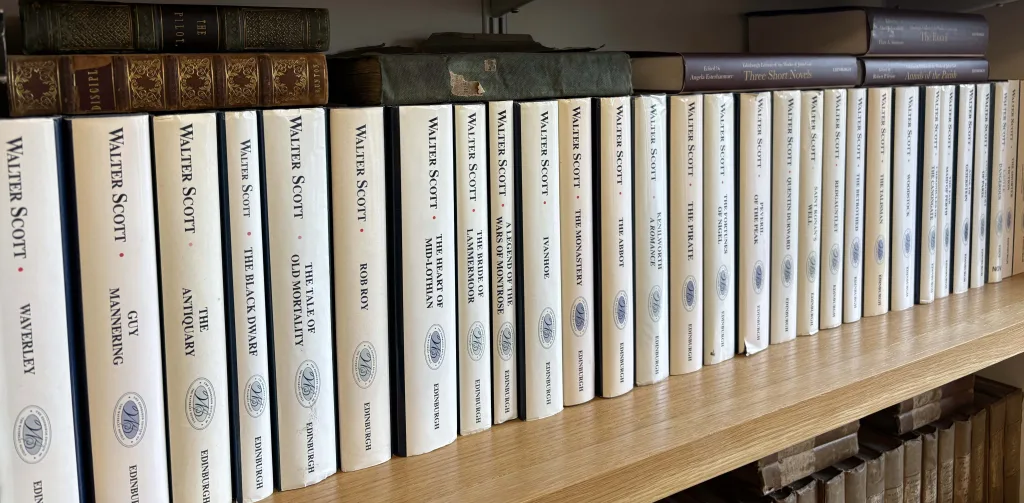
During the height of the pandemic, I found myself going back to Walter Scott’s historical fiction. In the end, I managed to get through all 27 (yes, 27) of his novels. It’s an astonishing body of work. I’d say Guy Mannering (1815) and Redgauntlet (1824) are my favourites, but you might get a different answer tomorrow.
What is your favourite quotation from a character in a book, or directly from the author that inspires you?
Here’s a thing that isn’t actually written down. I was really ill when I was about 12 and when I got out of hospital my dad read Tolkien’s Lord of the Rings trilogy aloud to me, a chapter each night. Plus, he did all the accents and would go wildly off script, with Gandalf harumphing, Sam monologuing, Treebeard saying nothing for what felt like hours. It was so good.
But you want an actual quote, so here’s one that was a favourite with writers I work on in my research, which focuses on the late eighteenth and early nineteenth centuries. It speaks I think to the foundational question of literature’s role in creating our reality:
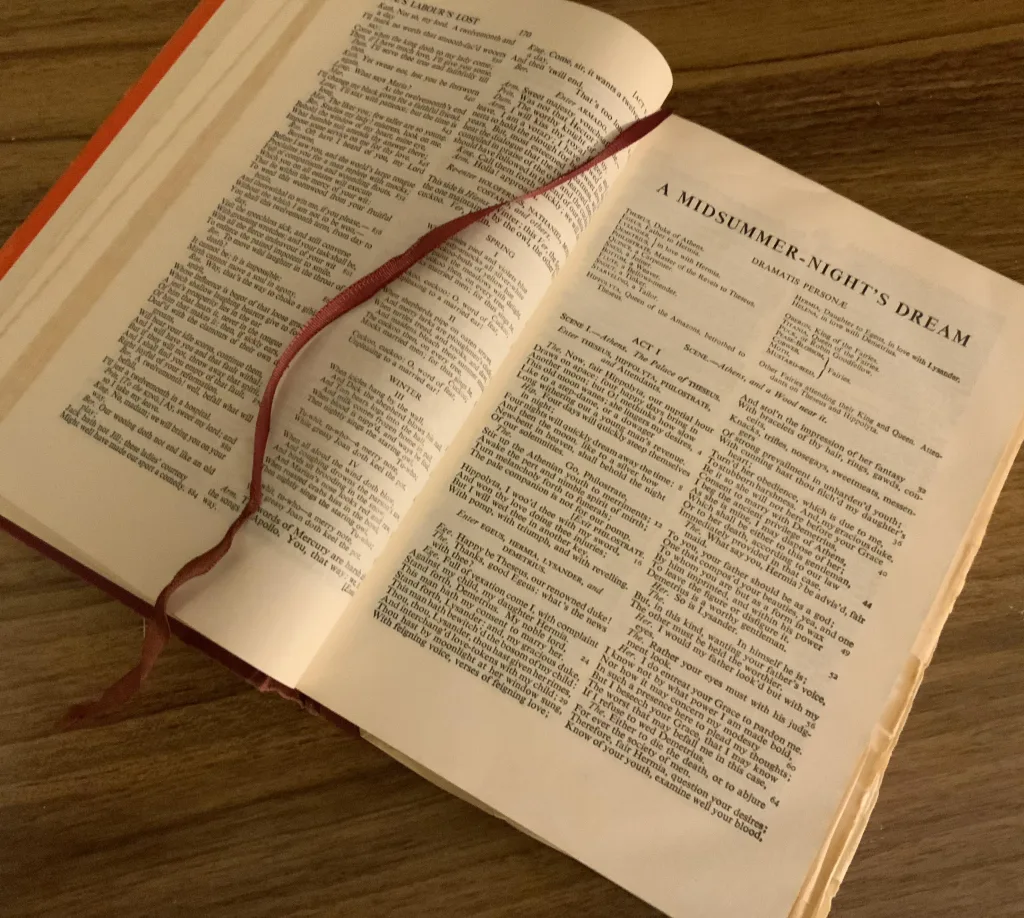
And as imagination bodies forth
The forms of things unknown, the poet’s pen
Turns them to shape, and gives to airy nothing
A local habitation and a name.
(Shakespeare, A Midsummer Night’s Dream, v.i.14–17)
Which literary book do you wish you had written?
My first thought here was James Hogg’s The Private Memoirs and Confessions of a Justified Sinner (1824), which to me is word-perfect for long stretches. It’s not just a mind-bending account of religious fanaticism but also an experiment in the limits of the book as a carrier of meaning.
But I’m going to say Laurence Sterne’s The Life and Opinions of Tristram Shandy (1759–67), which bears some similarities to Hogg’s novel by seeming to anticipate the formal qualities of postmodernism by several hundred years. Plus, it’s an extraordinarily funny work that speaks to my sense of humour. Sterne’s effortless-feeling brilliance is never far from a puerile joke – in fact he can give you a big philosophical idea and a joke bound up as one. I like that.
What books are in your top ten reads?
Ouch, I’m going to need some disclaimers.
I’ve put these in chronological order instead of trying to rank them. I’m shamelessly cheating by not including books I’ve already mentioned. I’m also assuming that I already have Shakespeare and the Bible, Desert-Island-Discs-style…?
I’ve not put in anything too obscure (sorry, John Mactaggart’s Gallovidian Encyclopedia [1824]). Actually some of my picks are obvious, but they’re obvious for a reason. There’s also definitely a bias towards substantial-seeming tomes here; that’s probably a bad impulse but there you have it.
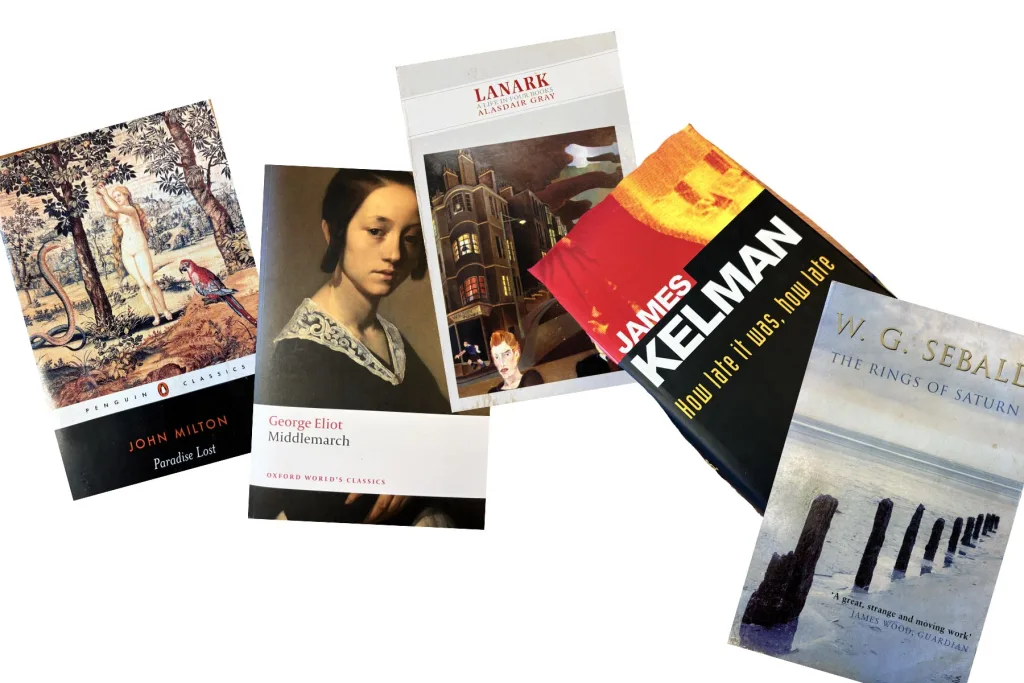
- John Milton, Paradise Lost (1667). An undeniable, titanic masterpiece, but also a lot of fun.
- Robert Burns, Poems, Chiefly in the Scottish Dialect (1787). The book that really launched Burns; his second edition, published in Edinburgh. It’s hard to imagine my line of work without it.
- George Gordon, Lord Byron, Don Juan (1819–24). I particularly enjoy Canto 9, but the writing in general is wildly good.
- Thomas Carlyle, Sartor Resartus (1833–34). Philosophy and literary anarchy in a sublime Tristram Shandy for the nineteenth century.
- George Eliot, Middlemarch (1871–72). Not undeserving of its status as ‘the’ 19th-century novel. I recommend Juliet Stevenson’s audiobook of it, if you’re into them.
- Thomas Pynchon, Gravity’s Rainbow (1973). Anything by Pynchon could have made this list, but this one might be my favourite book of all.
- Ursula K. Le Guin, The Dispossessed (1974). An amazing document of the radicalism of the 1970s.
- Alasdair Gray, Lanark (1981). I remember coming to this one at just the right time in my life. Gobsmackingly ambitious.
- James Kelman, How late it was, how late (1994). There’s nothing quite like it; rightly casts a long shadow over the Scottish literary world.
- W. G. Sebald, The Rings of Saturn (1995). A novel, sort of, but also a lot of other things all at the same time.
What are you reading for personal enjoyment at the moment – and would you recommend it to your students?
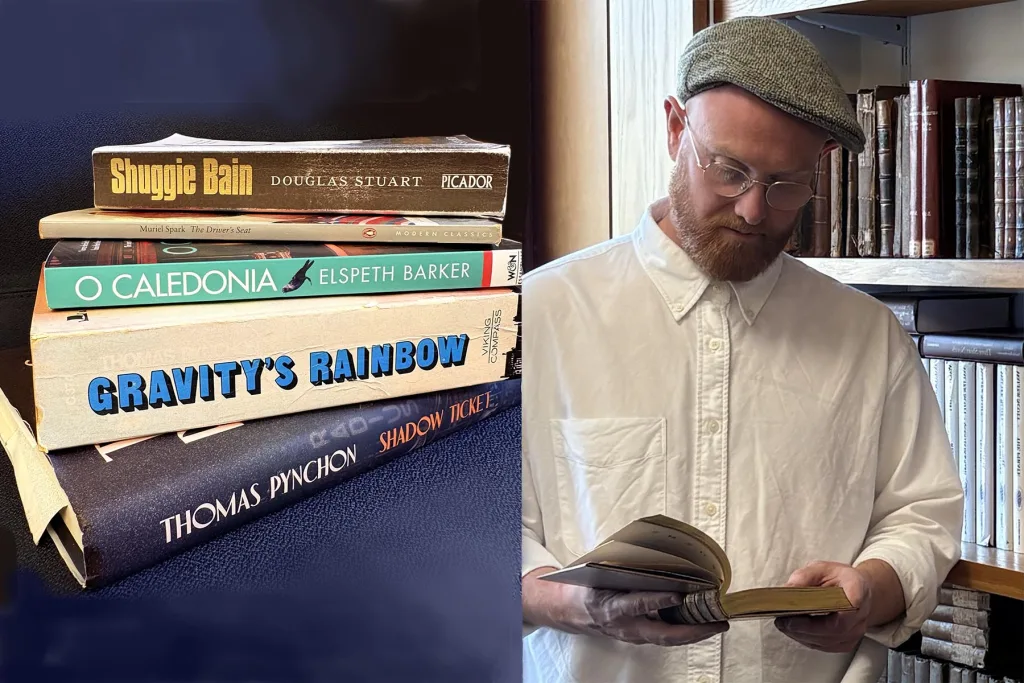
I’m working through Thomas Pynchon’s new one, Shadow Ticket (2025) right now. It’s the most classically noir of Pynchon’s detective novels to date, set in the 1930s, initially around Milwaukee and Chicago. Economic depression, rising fascism and an international cheese conspiracy. There’s a bit of a 1930s zeitgeist just now (Sinners comes to mind). It’s not difficult to see why (and it’s not cheese).
A book that might appeal more directly to my students doing Scottish topics is Douglas Stuart’s Shuggie Bain (2020), which I only got around to recently even though it won the Booker Prize. I think it was completely deserving of that. It’s often harrowing in its account of Shuggie and his mum Agnes, and her struggles with alcohol, such that I don’t know if ‘enjoyment’ quite captures the experience. But it’s extraordinarily beautiful too; the writing is so good.
Final thoughts
Let me give a quick plug for EDITION, which is the University’s new book history and textual editing initiative. We’re doing this interview because of the National Year of Reading, and of course, reading is the primary form of our relationship to books.
But EDITION is also interested in all the other ways we can relate to books: making them, remaking them, handling them, counting them, cataloguing them, dissecting them, borrowing them, annotating them, selling them, collecting them, fetishizing them, forgetting them, mapping them, gifting them, judging them by their covers, staining them, pirating them, censoring them, recovering them, repairing them, telling stories about them, cooking from them, singing from them and so on and so on.