
During 2026, the National Year of Reading, we ask our teachers of all things literary, just what they recommend as a good read, and which books inspire them in their teaching.
Dr Owen Holland, Lecturer in Nineteenth-Century Literature
Which books do you love using the most in your teaching and why?
The most teachable texts are the ones that keep generating new ways of thinking about them, even after multiple readings. Working on the 19th century, I’m spoilt for choice in that respect. I do find Wordsworth’s Prelude, Eliot’s Middlemarch and Hardy’s Tess of the d’Urbervilles particularly generative in seminar conversations — but that’s all thanks to the students, really.

Which book to you return to for inspiration and personal enjoyment, or do you never return to a title once you’ve read it once?
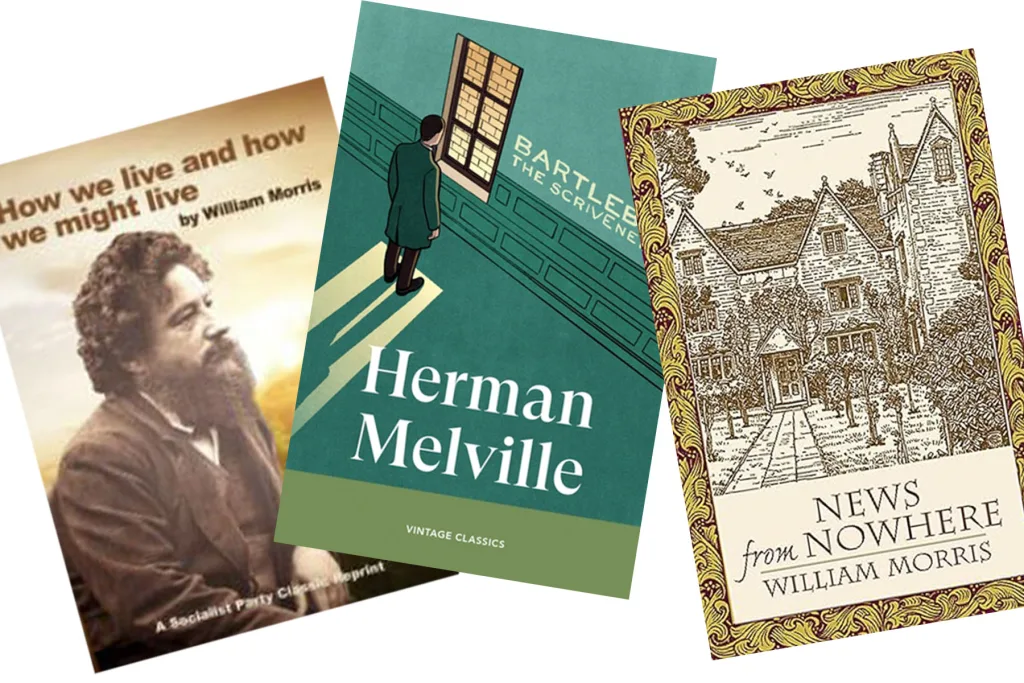
I do often re-read particular works, and — sometimes to my surprise — I still find myself returning to William Morris’s News from Nowhere quite a bit. Once a year I teach it on a third-year option course Literature, Revolution and Rebellion in the Long Nineteenth Century.
What is your favourite quotation from a character in a book, or directly from the author that inspires you?
Here is one from the opening of William Morris’s 1885 lecture ‘How We Live and How We Might Live’:
‘The word Revolution, which we Socialists are so often forced to use, has a terrible sound in most people’s ears, even when we have explained to them that it does not necessarily mean a change accompanied by riot and all kinds of violence, and cannot mean a change made mechanically and in the teeth of opinion by a group of men who have somehow managed to seize on the executive power for the moment. Even when we explain that we use the word revolution in its etymological sense, and mean by it a change in the basis of society, people are scared at the idea of such a vast change, and beg that you will speak of reform and not revolution. As, however, we Socialists do not at all mean by our word revolution what these worthy people mean by their word reform, I can’t help thinking that it would be a mistake to use it, whatever projects we might conceal beneath its harmless envelope. So we will stick to our word, which means a change of the basis of society; it may frighten people, but it will at least warn them that there is something to be frightened about, which will be no less dangerous for being ignored; and also it may encourage some people, and will mean to them at least not a fear, but a hope.’
Which literary book do you wish you had written?
That would have to be Herman Melville’s short story ‘Bartleby, the Scrivener: A Story of Wall Street’ (1853). Bartleby is usually thought of in connection with his well-known catch-phrase: ‘I would prefer not to’. As it happens, I first came across the story in reading contemporary critical theory – particularly Giorgio Agamben’s and Slavoj Žižek’s discussions of Melville. Bartleby embodies a stance of truculent refusal, not quite intransigence, but a kind of passive resistance. It’s a very pure form of negation that can tarnish even the shiniest of contemporary neoliberal surfaces. I’m very grateful to Melville for having given that to the world.
What books are in your top ten reads?
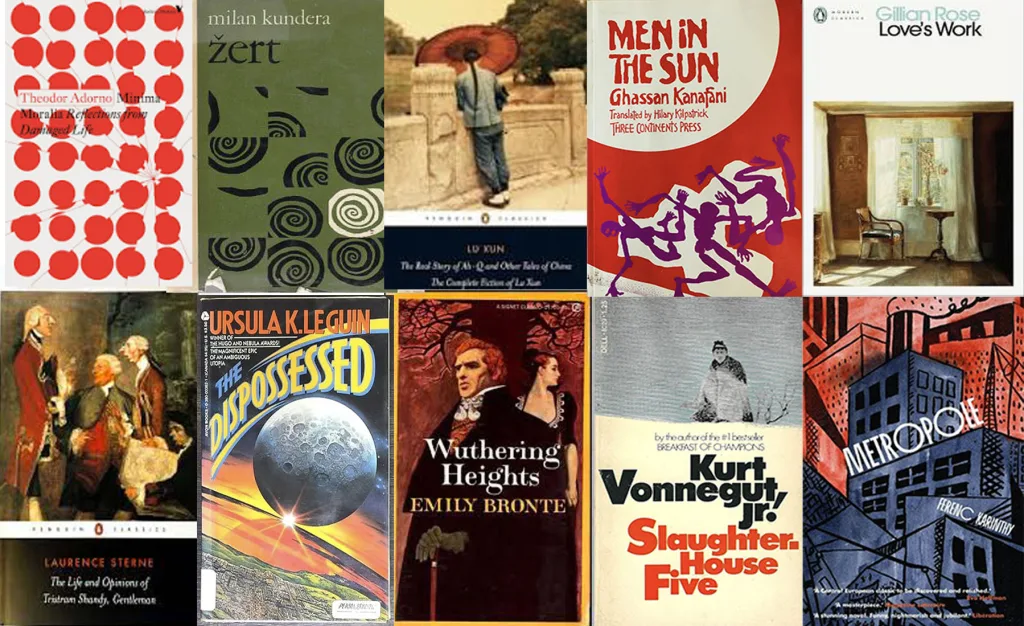
It’s a bit of a moveable feast, really, since I’m quite sceptical of the ‘top ten’ format. At the moment, and in no particular order, it’s a rather raggle-taggle list:
- Ghassan Kanafani’s Men in the Sun (1962), translated by Hilary Kilpatrick;
- Ferenc Karinthy’s Metropole (1999), translated from Hungarian by George Szirtes;
- Kurt Vonnegut’s Slaughterhouse-Five (1969);
- Gillian Rose’s Love’s Work (1995);
- Lu Xun’s ‘The Real Story of Ah-Q’ (1921-22), translated by Julia Lovell;
- Theodor Adorno’s Minima Moralia: Reflections from Damaged Life (written between 1944 and 1947), translated by Edmund Jephcott;
- Ursula K. Le Guin’s The Dispossessed (1974);
- Milan Kundera’s The Joke (1967). Dis-satisfied with several English-language translations of his work from Czech, Kundera eventually did it himself in 1991. The novel turns on a mis-interpreted joke about Trotsky, and I wanted to smuggle Trotsky in somewhere;
- Emily Brontë’s Wuthering Heights (1847);
- and, to end with a novel that problematises beginnings, Laurence Sterne’s The Life and Opinions of Tristram Shandy (1759). I could keep going, but I think I had better stop there.
What are you reading for personal enjoyment at the moment – and would you recommend it to your students?
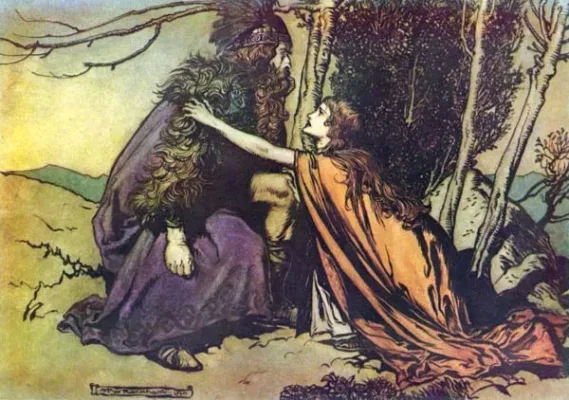
Currently, I am reading Mark Mazower’s The Greek Revolution: 1821 and the Making of Modern Europe. My wife is Greek, and so I try my best to familiarise myself with the history of modern Greece. I also greatly admire Mazower’s historical writing. At the same time, I am working my way through Margaret Armour’s English translation of the libretto for Wagner’s Ring Cycle. This is because I recently came across a very under-priced copy of an edition that includes Arthur Rackham’s wonderful illustrations, (see an example in the main image) which I quickly snapped up. I can’t recall where I first came across Rackham’s drawings – probably in some family-related context. They now feel very familiar, as if I have always known them. Would I recommend these works to students? Yes, if relevant to particular research projects.
Further reading
Owen Holland is the author of Literature and Revolution: British Responses to the Paris Commune of 1871 and William Morris’s Utopianism: Propaganda, Politics and Prefiguration. He is a former editor of The Journal of William Morris Studies.
Feature image: An illustration by Arthur Rackham for Richard Wagner’s The Rhinegold and the Valkyrie, originally published by William Heinemann, 1910. Source: art passions.net